
August 26, 2025
Last week I had a life-altering experience: I fell in love with Hawaiʻi’s nonnative birds.
Because of my interest in the marine world, I’ve spent most of my outdoor life either snorkeling, beach combing, or scanning the ocean’s surface from the deck of my sailboat. Marine animals, including seabirds and shorebirds, were my focus. Land birds, not so much.
But thanks to Noelle Sutherland of Wahiawa’s Rainbow Seniors, I have a new passion. In May, Noelle invited me, as a representative of the Hawaiʻi Audubon Society, to speak to her group. When I asked what birds she had in mind, thinking I would talk about our native plovers or terns, she said, “Mynahs and doves and cardinals. You know. The birds we see in our yards.”
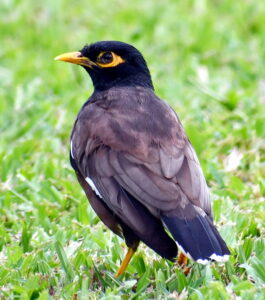
Native to India, myna birds were introduced to Hawaiʻi is 1865 to eat insect pests. The birds also eat fruit and scraps. ©Susan Scott
Well, then, I had homework to do. And in preparing that slide show (well-received by that friendly group), I learned more about Hawaiʻi’s nonnative birds. And in that, my park walks, sidewalk strolls, and cafe visits have opened up a whole new world.
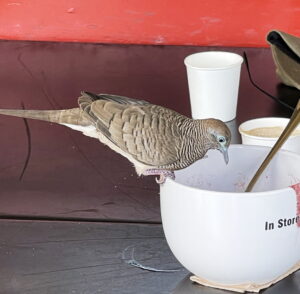
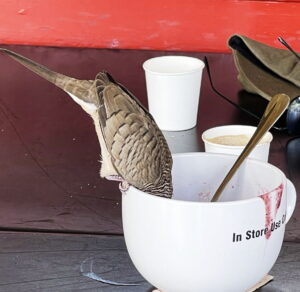
Are you going to finish that? A Zebra Dove noticing foam left in a cappuccino. (Island Vintage Coffee, Haleʻiwa.) Susan Scott
People have been bringing birds to Hawaiʻi for centuries. The first nonnative birds arrived in Hawaiʻi with the first humans about 1000 A.D. Ancient Polynesian voyagers from the Marquesas, brought with them Red Junglefowl, the ancestors of today’s chickens. Red Junglefowl, however, were not native to the Marquesas, but rather came from Southeast Asia. Humans have been breeding and transporting chickens around the world since 6,000 B.C.
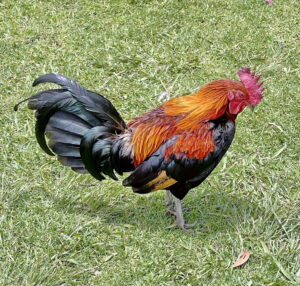
A handsome rooster at Kōkeʻe State Park © Susan Scott
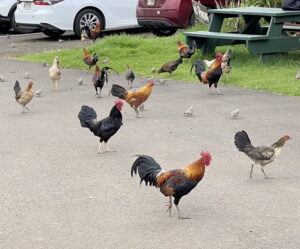
Shown here are the well-known chickens of Kōkeʻe State Park on Kauaʻi. These are hybrids of Red Junglefowl and domestic stocks. © Susan Scott
Migrating humans have been importing pigeons, native to North Africa and Europe, for food and as messengers for at least 5,000 years. In 1606, English colonists brought pigeons with them to the Jamestown Settlement in the Colony of Virginia. Pigeons (AKA Rock Doves) first arrived in Hawaii aboard a vessel from China in 1788, followed in 1796 by an unknown number of domestic pigeons from Europe to Oahu. All quickly made themselves at home in the wild.
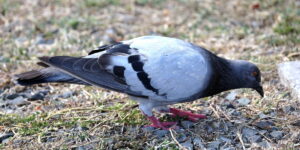
Pigeons have an almost unlimited variety of feather colors and patterns. © Tom Fake
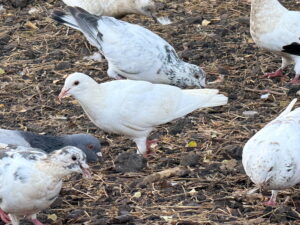
Oʻahu hosts an unusual number of white pigeons. These may be the descendants of white pigeons imported from Canada in 1874 by King Kalakaua for the dedication of the Kapiʻolani Bird Park. White and white-mottled pigeons, Waialua, O’ahu. ©Susan Scott
Bird imports, both legal and not, continue to this day with people bringing birds to Hawaiʻi to eat, hunt, hear, or watch. Because of birds’ nearly endless diversity, they can be pets or pests, songsters or screechers, insect controllers or fruit destroyers. Sometimes the same species are all of the above.
So far, people have released at least 211 species of nonnative birds in Hawaiʻi. Approximately 54 of those have established wild, self-sustaining breeding populations known as naturalized. This means the species can continue to exist without further human assistance.
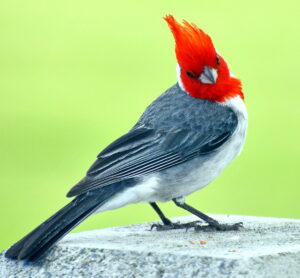
Red-crested Cardinal (adult.) We often call these birds Brazilian Cardinals but they are native to northern Argentina, Bolivia, Southern Brazil, Paraguay and Uruguay. Males and females look alike. Punchbowl Cemetery. ©Susan Scott
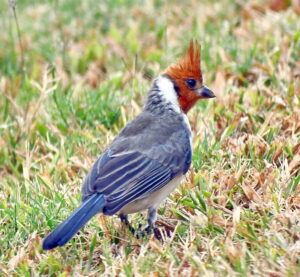
Immature Red-crested Cardinals have brown heads. Introduced to Oahu around 1930, the species is now common throughout the lowlands of the main Hawaiian Islands. ©Susan Scott
So bravo, you raucous mynahs, cooing doves, and clucky hens. Along with your 53 fellow naturalized species, you survived the move to Hawaiʻi and today add color, song, and spirit to our lives.
I’m still spending my outdoor time looking down, but instead of fish, crabs, and sea urchins, I’m marveling over cardinals, doves and mynah birds. Thank you, Noelle and the other Rainbow Seniors for turning my morning walks into urban wildlife adventures.