
 July 10, 2025
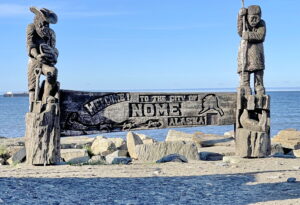
I recently returned from my third “Kōlea Quest,” a Hawaiʻi Audubon Society-sponsored trip to Nome, a coastal town on the Bering Sea.
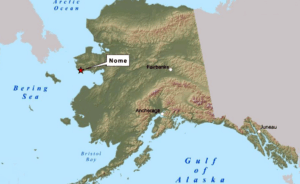
In summer, the Nome area is often rainy, always buggy, and so remote that services are limited and expensive. But the roads through Nome’s tundra expanses offer some of the few places people can see plovers nesting. And for us kōlea fans, that makes Nome visits a rare treat.
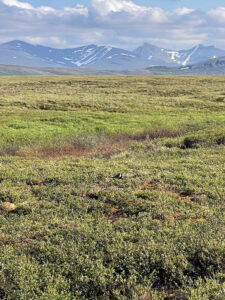
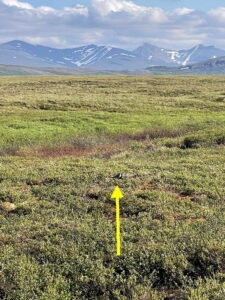
Pacific Golden-Plovers can be hard to spot on the Nome tundra. ©Susan Scott
Although the plovers we admire during our Nome trips look identical to those in Hawaiʻi, they are not Hawaiʻi’s plovers. We know from Wally Johnson’s tracking studies that Hawaiʻi birds nest in Alaska areas south of Nome, such as the Yukon-Kuskokwim Delta. This vast expanse, about the size of Louisiana, is part of the Yukon Delta National Wildlife Refuge. Our birds also breed in the Alaska Peninsula that extends to the Aleutian Islands.
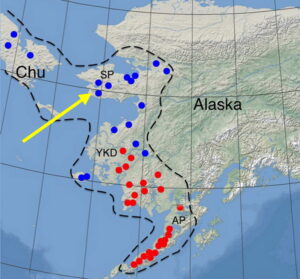
Red dots: Hawaii birds. Blue dots: South Pacific birds. Yellow Arrow: Nome. (SP: Seward Peninsula. YKD: Yukon-Kuskokwim Delta. AP: Alaska Peninsula. Chu: Chukotka, Russia.) © Oscar W. Johnson graphic
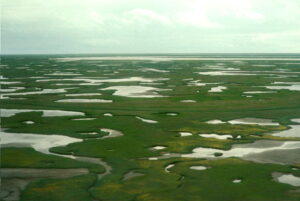
The Y-K Delta is wetland tundra, a habitat Pacific Golden-Plovers prefer over drier tundra. Kuskokwim Delta Wetlands Aerial View. David Cline, USFWS
The birds we see in Nome may have never seen Hawaiʻi, but they’re kindred spirits, having migrated from Tahiti and other South Pacific islands. These birds fly farther than Hawaiʻi’s birds, and therefore, stop in Japan to refuel. After gaining weight by eating bugs in rice fields, the birds continue north, some to Nome, others farther north in Alaska or Siberia.
Of course, given nature’s quirks, there are exceptions. One male kōlea Johnson satellite-tagged at Punchbowl Cemetery in 2022 went to Alaska, then Russia, then Mokumanamana (formerly Necker Island) in Hawaiʻi’s Northwest Chain where the bird’s signal stopped. That amazing world traveler, nicknamed Mr. Necker, then delighted us all by showing up in Punchbowl on October 10th (better late than never) exactly where we tagged it.

A happy Wally Johnson removing Mr. Necker’s spent satellite tag ©Susan Scott
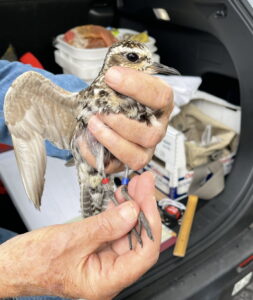
We’ll will be looking for Mr. Necker, identified by his blue and red legs bands, at Punchbowl this year. ©Susan Scott
When in Nome, we have the privilege of seeing American Golden-Plovers as well Pacific Golden-Plovers. The two were once considered one species, called the Lesser Golden-Plover. But in 1993, researchers discovered that although both types breed in the same Arctic areas, each has a distinct call, the two prefer different habitat (the Americans like dry tundra), and they don’t interbreed. In addition, the two species spend winters in different places, the Americans migrating to South America, and the Pacifics migrating throughout the Pacific.
The two species also look a bit different:
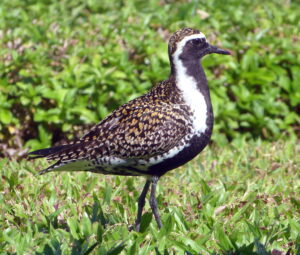
The male Pacific plover’s white stripe widens down the side and angles back. © Susan Scott
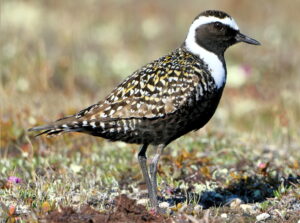
The male American plover’s white stripe ends on the upper breast, and the birds have less gold in the feathers. © Ian K. Barker, Birds of the World
We Hawaii residents visiting Nome know that the Pacific Golden-Plovers we see are not Hawaiʻi birds, and we also know that we’re sometimes viewing American Golden-Plovers. No one cares. Besides enjoying Nome’s countless charms — Arctic wildlife, Iditarod fame, gold rush history, super-friendly residents — getting to see any plover in it’s Alaska breeding grounds is the thrill of a plover lover’s lifetime.